


Keep your boiler, replace it or switch to a heat pump? Before choosing the equipment, understand what your home needs.
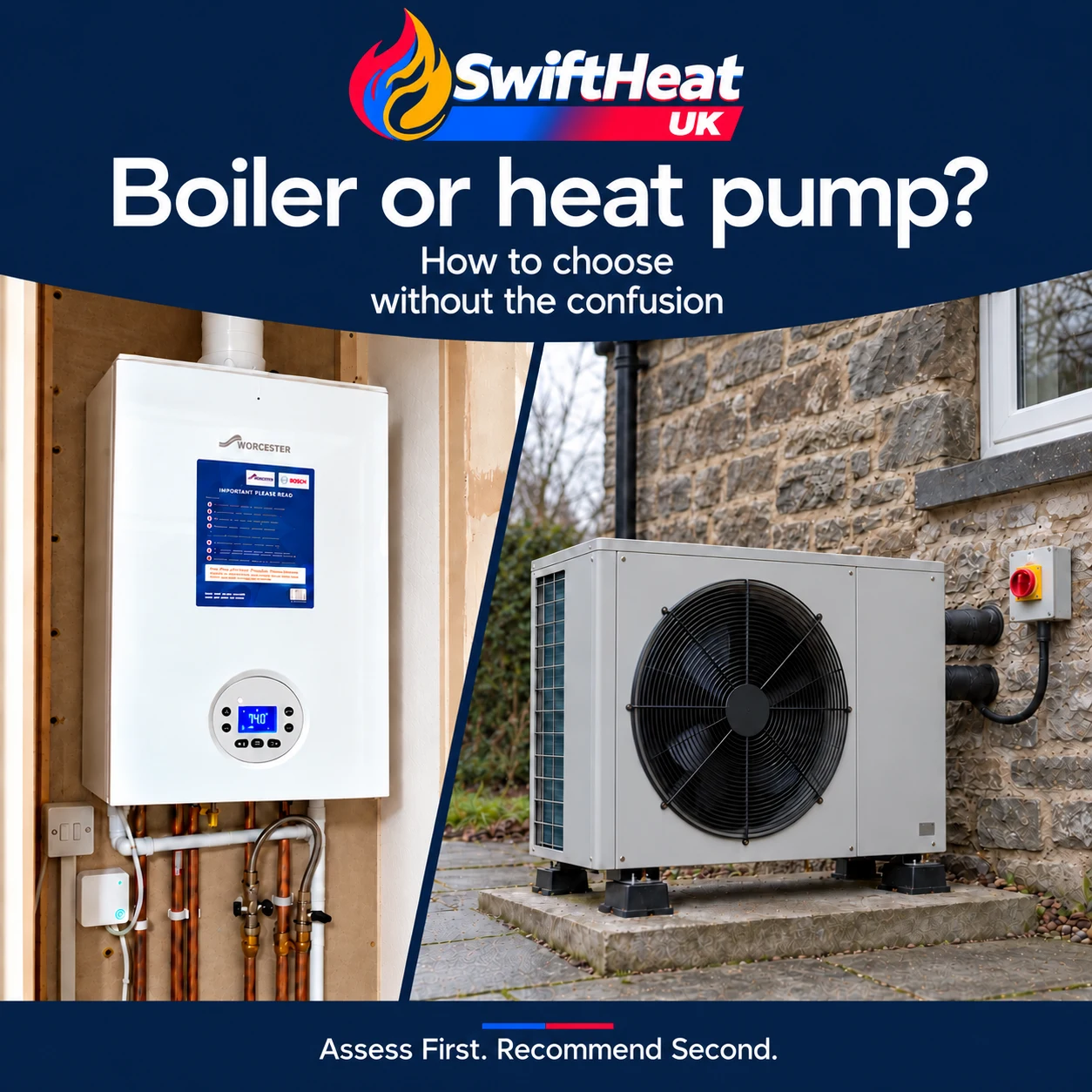
When you spend money on heating, you want more than a new appliance. You want a warm home, dependable hot water and a clear understanding of the bills and maintenance ahead.
Yet choosing between a boiler and an air source heat pump can feel confusing. Headlines promise savings, advertisements focus on grants, and recommendations do not always explain what the change would mean for your property.
At SwiftHeat UK, our starting point is simple:
Assess First. Recommend Second.
Good advice should leave you understanding your options—and confident about the decision you make.
Start with the problem you want to solve
Is your boiler breaking down? Are some rooms difficult to heat? Does your household need more hot water? Or is everything working, but you want to plan for the future?
These are different situations. They deserve different recommendations.
| Your situation | What to explore first |
|---|---|
| Your heating is reliable and meets your needs | Whether keeping it, with appropriate servicing and maintenance, remains sensible |
| Rooms are cold or temperatures are uneven | The cause before assuming a replacement appliance will solve it |
| Repairs are frequent or expensive | The repair options, expected reliability and complete replacement costs |
| You are extending or renovating | The heating and hot-water needs of the finished property |
| You want to move away from fossil-fuel heating | Heat-pump suitability, installation requirements and realistic running costs |
A worthwhile assessment may lead to keeping, improving or replacing your system. Replacement should have a clear justification.
What makes a home suitable for a heat pump?
The age of your home alone does not decide the answer. Heat pumps can serve a wide range of properties, but the system must be designed around the building’s requirements. (Energy Saving Trust)
For a heat-pump proposal, ask for a room-by-room heat-loss assessment. Your installer should explain how the findings inform the equipment selection, radiator requirements and proposed operating temperatures.
The discussion should also cover existing pipework, worthwhile insulation improvements and your household’s hot-water demand.
A model number and a price are not enough. You should understand why the proposed system suits your home.
Efficiency and savings are different things
Heat pumps use electricity to transfer heat into your home. They can supply several units of heat for each unit of electricity consumed, but that does not automatically make them cheaper to run than a newer gas or oil boiler.
The financial comparison depends on your energy prices, the system being replaced and the performance achieved in use. (Energy Saving Trust)
A simple running-cost example
These figures are illustrative assumptions—not current tariffs or a forecast for your home:
- Gas: 7p per kWh
- Electricity: 28p per kWh
- Boiler efficiency: 90%
- Heat-pump performance: an average of 3.5 units of heat per unit of electricity
| System | Calculation | Energy cost per kWh of useful heat |
|---|---|---|
| Boiler | 7p ÷ 0.90 | 7.8p |
| Heat pump | 28p ÷ 3.5 | 8.0p |
If the heat pump averaged four units of heat per unit of electricity, its figure would fall to 7.0p.
The example excludes standing charges, servicing and other costs. It shows why the tariff and achieved performance must be considered together.
Ask for an estimated annual running cost, with the energy prices, heat demand and efficiency assumptions stated. You should be able to see how the estimate was reached.
What would change in your home?
This guide focuses on air-to-water heat pumps, which supply heat through a water-based heating system.
A typical installation needs a suitable outdoor location and space for hot-water storage. Unlike a combi boiler, it usually supplies domestic hot water from a cylinder. Some radiators may need upgrading, depending on the design. (Energy Saving Trust)
Before accepting a quotation, establish:
- Where the outdoor unit and hot-water equipment will go.
- Which radiators or pipework need changing, and why.
- What disruption the work will involve.
- How the heating and hot-water controls will operate.
Radiator sizing, the electricity tariff and control settings all influence heat-pump running costs. A thorough handover should explain how to use the finished system effectively. (Energy Saving Trust)
Comfort depends on the complete installation and how it is operated.
Keep, replace or switch?
Keeping your boiler deserves consideration when it remains safe, reliable and suitable for your needs. The assessment may identify useful improvements without requiring replacement.
Replacing your boiler deserves consideration when replacement is justified and you want to compare the cost, disruption and performance of retaining a boiler-based system.
Switching to a heat pump deserves consideration when you want to move towards low-carbon heating and the assessment supports a practical design, an acceptable project cost and a clear understanding of running costs.
Your budget, priorities and plans for the property belong in that decision alongside the technical findings.
Compare the whole quotation
A lower headline price can include less work or support. Compare the scope of the finished installation:
- Equipment, installation and necessary system alterations.
- Electrical work, removal and disposal.
- Testing, commissioning and applicable certification.
- Controls, demonstration and handover.
- Warranty conditions, servicing and aftercare.
- Confirmed funding and the final amount payable.
Ask what is excluded and what circumstances could result in additional charges.
A clear quotation should help you compare value, understand the work and plan your spending.
What funding is available?
As checked in October 2026, the Boiler Upgrade Scheme provides £7,500 towards an eligible air-to-water heat-pump installation in England and Wales.
An additional £1,500 is available until March 2027 where the property is heated by oil or LPG and has no mains gas connection. This brings the potential grant to £9,000, subject to the scheme’s eligibility requirements. (GOV.UK)
An appropriately MCS-certified installer handles the application. Confirm your eligibility, the applicable grant and the remaining amount payable before committing. (Energy Saving Trust)
Funding can improve affordability. The proposed system must still suit your home.
Five questions before you commit
- Why is this option suitable for my property, and what assessment supports it?
- What work is included, and what could cost extra?
- What will I pay after any confirmed funding?
- How have the estimated running costs been calculated?
- Who will explain the controls and support me afterwards?
Clear answers give you something more valuable than a sales promise: a decision you can understand.
Your home. Your priorities. A clear recommendation.
You do not need to become a heating expert to make a good choice. You need advice that connects the technical findings to everyday life—warm rooms, sufficient hot water, manageable costs and dependable support.
Whether you are considering improvements, a replacement boiler or an air source heat pump, SwiftHeat UK begins by listening, assessing and explaining your options.
Speak to SwiftHeat UK Group Ltd about your home heating.
Call free: 0800 043 3464
Email: info@swiftheatuk.co.uk
Gas • Oil • LPG • Air Source Heat Pumps
Assess First. Recommend Second.
Engineering. Care. Accountability.