

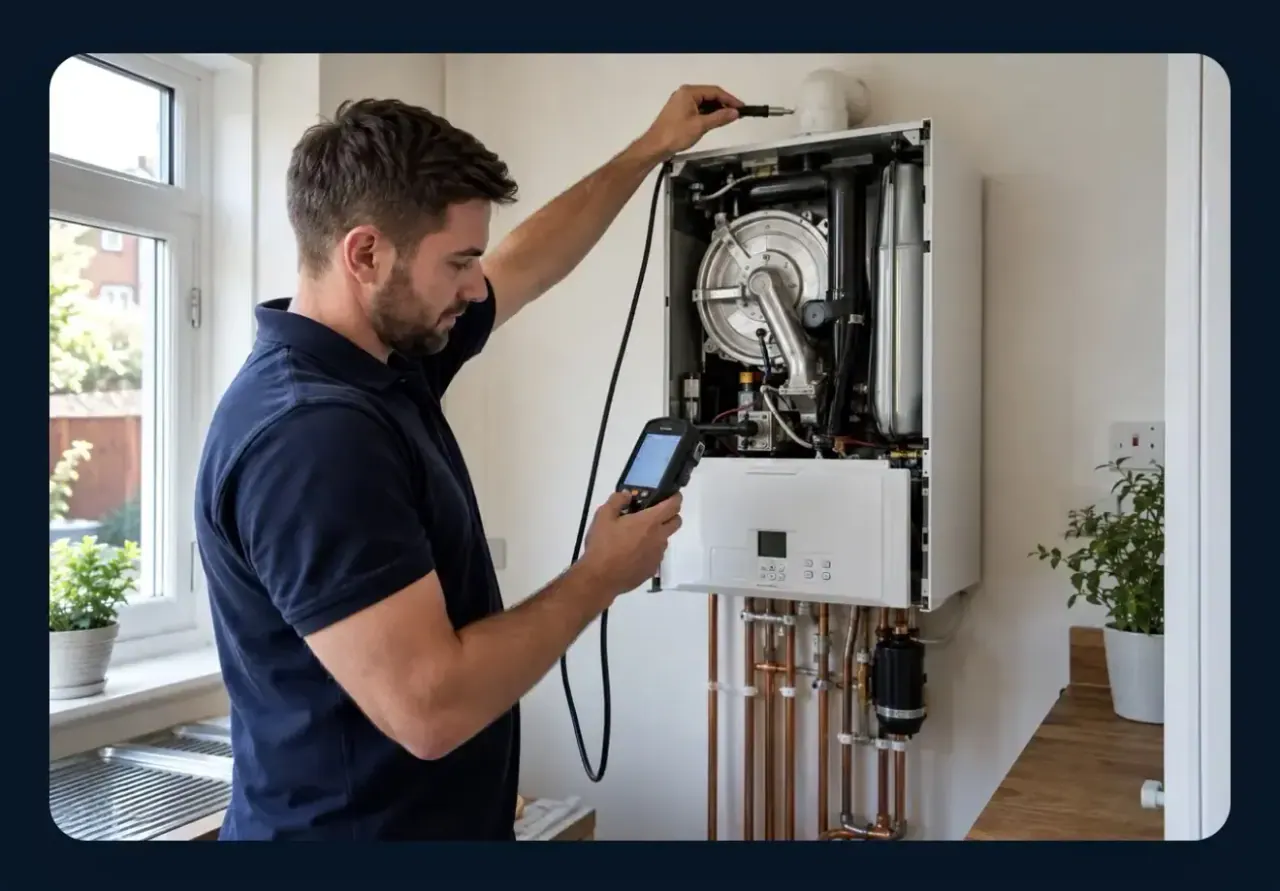
Two requirements, one coordinated design
The home’s heating requirement and the household’s hot-water demand need separate consideration. Heat loss helps establish the heating load; bath, tap and shower use informs the hot-water arrangement.
Property size, bedrooms, radiators and bathrooms provide useful context, but none is a complete sizing rule. An experienced assessor combines those details with the actual installation and supply conditions.
What we consider about your current home
We establish the existing boiler type, how hot water is supplied, what cylinder or tank space is available, and the condition of relevant pipework. We also ask what works well and what you want to improve.
Available flow and dynamic water pressure help establish what mains-fed hot-water arrangements can deliver. Radiators, heating controls, insulation and room heat loss inform the heating design rather than simply repeating the old boiler’s output.
How your household uses hot water
Tell us whether several showers run together, whether baths are filled while other outlets are in use, and whether usage is concentrated at particular times. These patterns can matter more than the total number of bathrooms.
A combi provides instantaneous hot water; cylinder-based arrangements hold a reserve that needs suitable capacity and recovery. Neither approach is universally best. The aim is to match supply, demand and the comfort you expect.
Space, future changes and the complete scope
Available cylinder space, boiler access, flue position and the feasibility of pipework changes can affect the practical options. Removing storage may free space; adding it needs a suitable location and an assessed design.
Extensions, extra bathrooms, insulation work and changes in household size should be discussed before specifying the installation. Future plans deserve consideration, but they do not justify guessing an oversized appliance today.
Prepare for a useful conversation
You can start by sharing your postcode, current boiler details and photographs, the number of bathrooms and a short description of your hot-water routines. If you are unsure of the system type, say so: you do not need to identify every component yourself.
We use that information to explain the next assessment step. This guide offers education rather than an automatic recommendation; the final configuration and appliance specification follow a property and system assessment.
Compare the arrangements
Combi, system or heat-only?
These are typical arrangements, not a recommendation for your property. Fuel choice and the precise installation design are separate questions.
| Consideration | Combi | System | Heat-only / regular |
|---|---|---|---|
| Hot-water supply | On demand from the appliance | Stored in a separate cylinder | Stored in a separate cylinder |
| Storage space | Normally no separate cylinder | Cylinder space needed | Cylinder and other system components need space |
| Household use | Assess simultaneous demand against supply and appliance performance | Assess stored capacity, recovery and supply arrangement | Assess the existing stored-water arrangement and household demand |
| Heating circuit | Assess the existing circuit and proposed appliance requirements | Commonly sealed; confirm the exact design | Confirm feed, expansion, pump and controls arrangements |
| A key consideration | Incoming water flow and dynamic pressure | Cylinder compatibility and controls | Condition of the retained system and the effect of any conversion |
Bathroom count and model numbers do not establish the right configuration. A property assessment determines the appropriate design.
Configuration and fuel are different decisions
A combi, system or heat-only label describes the arrangement. Gas, LPG and oil describe fuel choices. The available supply, appliance compatibility and the installation design must be checked separately; a listed gas model is not automatically suitable for LPG or oil.
Understand what a boiler assessment considers · Explore your options with the Boiler FinderExplore the configuration guides
Read the arrangement that interests you, then discuss its suitability for your home.
Common questions about choosing a boiler
Which boiler type is best for my home?
There is no universally best type. The recommendation depends on heating demand, hot-water routines, water supply, available space and the condition and configuration of the existing system.
Can I choose a boiler type from bedroom count?
Bedroom count alone is insufficient. Heat loss, simultaneous hot-water demand, water-supply performance and installation requirements all affect the decision.
Do I need to know my current boiler type before contacting you?
No. Photographs and a discussion can help establish the starting point. We explain what needs checking before the installation is specified.
Understand the complete quotation
The boiler, warranty option, controls, flue and condition of the existing system affect the proposed work and price. Any cylinder changes, pipework alterations or conversion requirements should be explained before you agree to proceed. No generic guide can confirm a fixed installation price for your home.
Starting-package pricing and its conditions · Installation assessment and scope
0% finance options over 3, 6, 9 or 12 months may be available through Humm Group Limited, subject to application, eligibility, approval and provider terms. Any applicable deposit, fees and repayment conditions are confirmed during your enquiry/application. Read the full finance terms and charges.
Manufacturer warranty eligibility depends on the exact appliance and installation package. We confirm the applicable term, registration and servicing requirements in your quotation.
Your next step
Assess First. Recommend Second.
Tell us about your current heating, hot-water routines and plans for your home. We will explain the assessment needed before recommending a configuration or appliance.
Gas Safe registration 978273 · Cardiff, South Wales and across the UK.